Showing posts with label interior design. Show all posts

Monday, July 30, 2012

Opulent Window Dressing: Modern-Day Lace


Current and upcoming trends in textiles across the fashion industry include one keyword: Texture.  And, the way we are choosing to bring texture into our designs is expanding every day.  One of the most popular forecasted textures in fashion is the adaptation of historical lace designs.

Lace creates opulence within a space or design.  History reminds us of its value and extravagance dating back to Queen Elizabeth in the 16thC. It is important to note that the current trend does not include "vintage" references, but rather, specific historical references from such eras as Rococo, Renaissance, and Baroque.  How we are choosing to adapt them into our designs is left to artistic license.  The above prints by F. Shumacher show entire lace patterns arranged into a detailed graphic print.

Instead of taking entire lace patterns and creating a motif, one of the most beautiful textures comes from an up-close look at the open-work construction of lace design.  The fabrics above are wonderful examples of a suggestive lace motif.  If you look at the fabric print on the left-hand side, it almost appears to be snake skin which creates even more interest and textural appeal.

A more modern pattern of lace is looser in its historical translation and becomes a suggested outline of open-work lace.  These patterns are unlike the traditional soft and delicate feel, but rather, a bold, hard-lined translation often resembling a mosaic.

Outside of prints, layering lace on top of fabrics creates luxurious details. These details are emphasized when hues of gray, copper, and brass are woven into lace for modern-day appeal.

Are you using lace details in your designs?  How do you bring opulence into your space?


Fabric prints by F.Shumacher, Lace trim and overlays by Mariocuccheti Tessuti and Solstiss Lace

Monday, June 25, 2012

Ombré Design Trend

Finish selection shown from Aria Metal Hardware


As trends cycle throughout history, ombré is one that has been a domineering force in the new millennium.  Today's strong resurgence is seen in hair styles, fashion, upholstery, wall treatments, draperies and just about anything you can put a finish on.  It falls under the Eclectic genre of design and pairs well with metals, cool tones, and new-found objects.


The word ombré is a French term meaning shaded and is used to describe color that is graduated from light to dark and often into stripes of varying shades.  It is interesting that the first recorded use of the term was used to describe a dyeing technique with fabric in 1841.  However, the word was not entered into the Oxford English Dictionary until 2005.

top: homemaker.com, bottom: glamlamb.


Ombré draperies can be achieved with a Bohemian tie-dye of sorts or color-blocking, with finite attention to detail in the graduation of color within the fabric or finish.  Draperies are the most dramatic way to use an ombré finish in a room.  These treatments define the height in a room, create a cohesive design and direct the eye to the room's focal point or main motif.  Pairing metal drapery hardware with natural tones of satin nickel, brushed nickel and matte black with an ombré design creates a fluid and smooth transition from ceiling to floor or floor to ceiling.

The photos above create an ombré pattern using the entire space and draw the eye into the heart of the design.  The top photo defines the architectural focal point of the bay window and draws the eye down into the design while washing down and out through the floor.  The bottom photo does the opposite.  It washes down from the light ceiling and grounds the eye into the deep blues in the furniture and floor covering as the focal point in the room.


Wallpaper by Pierre Frey, Paris


Wall coverings and paint finishes are another dramatic way to add ombré to a space.  It can be accomplished with a sophisticated graduation of one color or many as shown above.


                                    Pillows by CapellaKid.etsy.com, Pouf by Surya

Accessories are an easy and subtle way to add ombré into a design. 


glamlamb, House Beautiful


There are many ways to add ombré both big and small into your design.  It can rejuvenate a tired old design or create Pop art in a new modern space.  Before you break out the Rit Dye, how will you choose to use ombré in your next design project?

Thursday, May 10, 2012

High Point Market: Resurgence of Color


Color is beginning to bloom back into our designs this Spring!  Even though hues of gray and burlap continue to appear on our design boards, we are breathing new life into the doldrums of tonal textures. The number one take-away from the Spring High Point Furniture Market: accents of color in Plum and pink.  We were surprised to see so much pink as Honeysuckle was Pantone's color of the year in 2011.  It did appear with a new coral twist and was used mainly as piping on upholstered furniture.  

We would be remiss not to mention this year's color, Tangerine Tango, which was well-represented.  However, plum, lavender, eggplant and every shade in between took center stage in almost every showroom as an accent piece.


In the Fall, we noticed some color mixing of a 70's throw-back, mustard yellow.  It has re-appeared in a brighter form this market and brings life to the neutrals that have become the basis for most of our design work.  Let the sun shine in!


Color was also well-represented in the abundance of hand painted furniture.  Bold graphic prints were mainly used on the individual pieces.  The most unique aspect of the hand painted furniture was adding/adhering a thick woven canvas on top of the wood structure.  Not only did this give it a fabulous texture and depth, it appeared as if it was wrapped in an artist's canvas.  They, themselves, seem to tell a story and would make for great conversation pieces in a any design setting.


Upholstered furniture and decorative nail heads continued as a trend this Spring.  Many of the designs used the burlap fabric motif, but we saw a mixing of brightly colored leathers and appliques into each new design. 

One new upholstered application did catch our eye.  We were intrigued by the use of fabric adhered (without batting) to wood furniture for texture and pattern.  Each fabric patchwork like the design above was outlined with small upholstery nails.  This handmade artisan detail transforms ordinary case goods into extraordinary ones.


Nautical has been around for several seasons as a popular design trend.   Crisp colors of royal and navy blue donned most of the designs, but we saw a cooler aqua and cornflower blue mixed in with deep coral shades.  It is apparent that this trend is here to stay for a while and with good reason.  They, too, bring life to even the most land-locked design and color to the doldrums of tonal textures.  


Texture continues to dominate interior design.  It is amazing that every market brings a new take on how to mix texture into design elements.  We saw new ways to tie off wool and felt to create sculptural pillows and rugs.  Sisal and jute were used as an old texture on new silk drapery panels.  This not only adds texture, but also, creates a malleable design style.  And, notice the Color in the drapery panels above: pink, coral, plum and straw.

We are excited by what we saw in High Point last month!  We cannot wait to see how you interpret and incorporate this Spring's design style into your treatments.  Injecting color into our designs no matter how slight, brings new energy and fuels our passion to add interest and zest into every creation.  

You now have permission to go Plum crazy!


Credits: Surya Rugs, Karen Robertson Nautical line, Guild Master, HP Furniture Market 

Monday, April 16, 2012

Pinterest for Design Professionals


If you haven't caught onto the craze of Pinning, you may be missing out on an important business tool as a professional designer or workroom.  This is no ordinary digital mood board; it is a powerful social platform for sharing ideas, products and photos from around the world.  For those of you familiar with Pinterest and are already in the throws of a late night Pinning addiction, you know about its magnetism.

How It Works
It is free to join and you can request an invite from Pinterest.com.  The "pins" are organized on Boards that you create to show your interests, hobbies, "wants", and anything that inspires you.  You can add a Pin It button to your Bookmarks Bar at the top of your web browser.  Simply click the Pin It button when you run across anything online that inspires you.  The social aspect is that you can also Pin other peoples pins, follow them or their boards.

Use It For Inspiration
Pinterest is a great website to visit for inspiration on any project.  You can search by Topic such as Draperies, Drapery Hardware, Interior Design, Sun Room, etc.  Or, you can search by product, company, website or source.  You can see what people are Pinning about Finestra here.


Create Boards for your Business
Organize business tools around the web, company resources, etc onto a Board.  This is a great bookmark and reference that you can revisit at anytime and access from anywhere with an Internet connection. 

Create a Board for How-To Videos and Webinars.  You can Pin directly from YouTube or Vimeo and choose the ones that are pertinent to your business or ones that you would like to catalog for later viewing.    We have pinned a Rowley video below on Sew-On Tapes.  Click to view a complete list of Rowley Videos, How-To's, and Webinars that you can add to your arsenal of business information.   
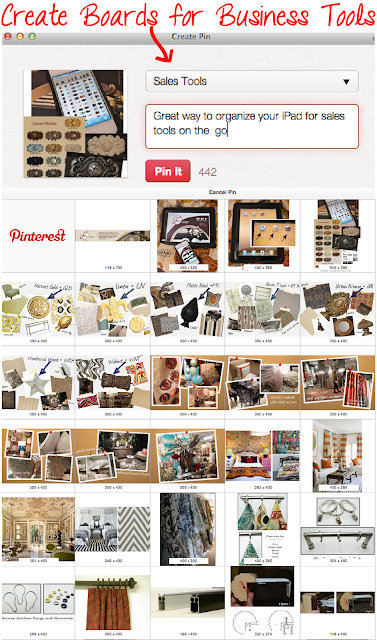
When you click on a blog or website such as FinestraDecorativeHardware.blogspot.com, all of the photos will pop up on your screen.  We have chosen to reference the Sales Tools to Go on our Pinterest Board and have added a description to remind us why we pinned it.


Create a Board as a Portfolio
It is important to follow some rules of etiquette when posting on Pinterest.  It is not a site to solely promote your business and spam everyone with only your creations.  This is a community and needs to be respected.  That being said, adding photos and links of your favorite projects or How-To's onto a Board is a great idea to round out your inspirations and Brand Yourself as a professional. 


Share Boards with Clients
This is one of the newest tools on Pinterest and one of the most exciting business tools!  

Clients depend on us to translate their emotions and needs into a cohesive design.  You cannot only point a client to look at your Pinterest Boards, but you can also share them.  What if you had your Boards organized into different design genres: Traditional, Eclectic, Mediterranean, Urban Loft, etc?  Or, by color?  Either email your Pinterest link to your client or review the Boards with them.  This may give them a better feel for your design style and help define theirs in the process.

A favorite way to interact with a client is to make them a Contributor.  You can edit an existing Board and add them as a Contributor or create a new one as we have done above.  We have titled it Jan's Garden Room.  Now both the designer and Jan can Pin to the same Board about inspirations that move them.  This is a great way to communicate with clients, define a style quickly and/or involve a hands-on client.

Share Boards with Co-workers or Industry Groups
Boards can also be used in collaboration with other design professionals about a joint project.  This would be a great way to communicate between a designer and a workroom for example.  They could share inspirations and even specific industry techniques that would help them work together to create the best end result.

Industry groups could also share a Board for designing and fabricating group projects for the community or even design ideas about an industry trade show booth.  

Whether you are a Pinterest veteran or an interested on-looker, now is the time to get Pinning!  This platform was made for our industry.  What inspires us, what we create and what our clients are drawn to are larger than words can describe, but a Photo on Pinterest can!


Wednesday, October 12, 2011

The Art of Layering Patterns


Patterns play an important role in interior design.  Patterns add color, depth, dimension and texture to any room or window treatment.  The scale of pattern may be small, medium or large in size and any patterns used in the same space must relate to each other in order to create a cohesive design.

When used properly, pattern can ground a design that shows two distinctly different shapes, scale and proportion.  The large bold orange striped draperies in this room anchor the small scale pattern in the floor coverings.  It allows the eye to see the design, color and texture as a whole and not as different distinct parts.
Designer Linda Allen
Believe it or not, pattern in design also signifies the shape of furnishings, lighting and accessories.  This particular design is very tonal with a pop of lime in the furnishings to ground the eye away from the multi-pattern ceiling treatment.  Take note of the chair back designs; they repeat the shapes in the mirrors, lighting, floor covering and the ceiling design.  This is a perfect reflection of using the shapes throughout a design to create an elegant and harmonious feel within the space.


Texture is created with pattern by directional movement and contrast.  These two designs use directional movement and distinct contrast in the black and white patterns.  Look closely at the Chevron design on the right.  Not only is it directional, it has a pattern within the pattern of a Greek Key design.  This adds depth and texture.

Think about how you use pattern in your designs.  How does it affect your design style?  Experiment with different scales, proportions, and colors to find the right balance for your next project and signature look.

Tuesday, November 16, 2010

'Tis the Season for Winter White


Winter White creates a classic design statement. Winter whites include softened whites, creams, and shades of gray, gold or beige. These warm colors are layered throughout a design to create depth and tonal drama. Woven fabrics, furs, burlaps, washed wood carvings, and distressed accessories are all
examples of this layered color.

Traditional design displays the warm tones of white and creates the warmth and glow within a space. Cooler tones are used for a more contemporary trend and create crisp and distinct design lines. These cooler tones favor the modern color
pallette of gray, silver, and oyster.


Elle Decor